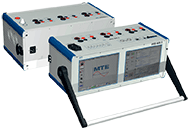
Class 0.02 Modular three-phase Portable Test System
- Reference standard module PRS 600.3, accuracy class 0.02
- Current and voltage measurement up to 120 A and 520 V
- Current and voltage generation up to 12 A or 120A and 300 V
- Vector diagram, harmonic spectrum, wave form and rotary field display, PQ measurement functions
- Burden measurement and ratio test of PTs and CTs
- Dimensions: W 510 x H 195 x D 480 mm
- Weight: approx. 29 kg
PTS 400.3 PLUS Three-phase, fully automatic test system with class 0.02 reference standard and integrated three-phase current and voltage source available in two versions.
For many years, electricity utility companies have realized the importance of performing measurements and tests, on-site, at the metering installation. MTE continually supplies and develops new and improved products that reduces and simplifies the on-site efforts.
The test system PTS 400.3 PLUS with enhanced functionality and high measurement accuracy does not only determine the accuracy of meters, but also provides additional information relating to the conditions at the respective mains points.
Two modules allowing combinations for
many applications
The PTS 400.3 PLUS system consists of the reference standard PRS 600.3 of class 0.02 and the power source module PPS 400.3, which is available in two versions of up to 12Aor 120A. The reference standard PRS 600.3 may be simply and quickly connected with the power source module PPS 400.3 thereby producing a portable test system with 1 up to 3 positions. Operation of the system may begin immediately after connecting both modules. In this combination, the reference standard controls the source via blue-tooth. Due to the extended power quality analyzer functions of the reference standard PRS 600.3, the test system can also be used to resolve disputes at contractual applications, for statistical surveys, including EN 50160 reporting, and for online troubleshooting of different kind of power quality problems.The power source module, if used without the PRS 600.3, can be controlled via the serial interface RS 232 C. It is therefore possible to easily apply the source module unchanged in a stationary test system. |